Product overview
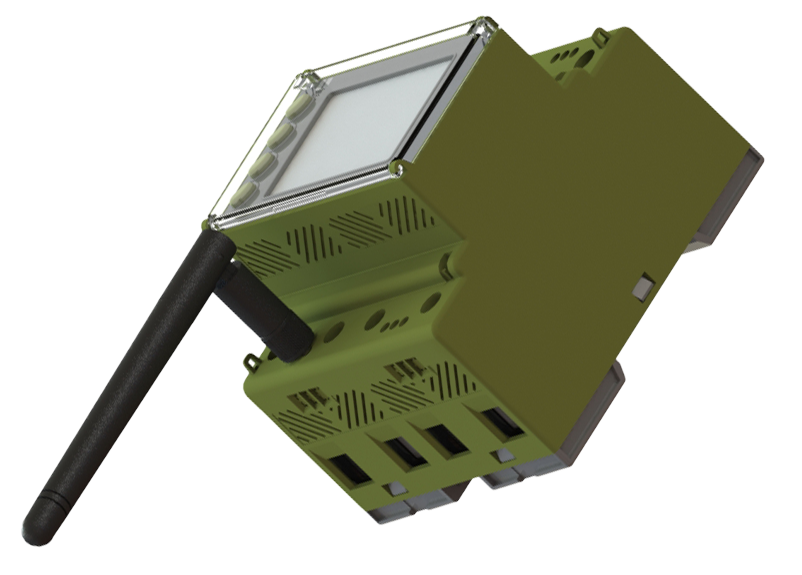
The YOBIIQ DEM4 provides three-phase energy measurement with demand and total harmonic distortion information. Direct and external-current-transformer variants cover different installation requirements, while LoRaWAN and Modbus RTU options connect the measurements to the chosen platform.
Each listed variant includes two digital inputs and two digital outputs. Use the direct model where the installation and current rating permit it, or select the CT version with appropriately specified current transformers for the measurement point.
Why choose DEM4?
| Capability | Benefit |
|---|
| Three-phase measurement | Monitor a distribution board or three-phase load. |
| Direct and CT versions | Match the meter to the wiring and current to be measured. |
| Demand and THD | Add load and waveform-distortion indicators to the energy record. |
| Two inputs and two outputs | Include I/O in the metering installation. |
| LoRaWAN or Modbus RTU | Choose the communication interface at ordering. |
Applications
| Application | Example uses |
|---|
| Commercial buildings | Measure consumption and demand across distribution boards. |
| Existing installations | Use a CT configuration where it suits the conductors and current range. |
| Industrial energy monitoring | Track three-phase energy and THD at selected measurement points. |
Each DEM4 variant, direct or CT, has two digital inputs and two digital outputs. Regulations required under the MID certification reserve the first digital output as a fixed S0 pulse output, used for verified consumption reporting to a separate metering or billing system. The second output is configurable and can switch based on consumption, voltage or current thresholds, making it suitable for a range of applications such as timer-based controls or prepaid/postpaid billing in combination with an external relay. The two digital inputs can register external contacts or events.
| Use case | Description |
|---|
| Tariff contact logging | Capture utility tariff state changes or external pulse contact events to correlate rate periods with measured consumption. |
| Breaker status feedback | Read auxiliary breaker contacts to confirm trip/open state and improve electrical incident visibility for maintenance teams. |
| Generator transfer state | Track ATS or generator run-state signals for runtime analysis, emergency readiness and post-event reporting. |
| Door / panel tamper event | Use a dry contact to register enclosure access and add a security audit trail to remote electrical rooms. |
| Prepaid or postpaid billing | Use the configurable output with an external relay to enable or disable supply based on prepaid credit or postpaid billing status. |
| Timer-based load control | Switch connected equipment on or off according to a configured schedule. |
| Remote load shedding | Drive a contactor or relay command to remove non-critical loads during demand peaks and avoid penalty costs. |
| Alarm beacon activation | Trigger visual or audible alarms when thresholds are crossed, making abnormal power behavior immediately visible on-site. |
| Controlled reconnect workflow | Support supervised remote reconnect procedures after validation checks in rental, tenant or temporary service scenarios. |
| Run/stop signal to auxiliary device | Send a simple control signal to ventilation, pump or process support equipment based on metering logic. |
| Closed-loop edge automation | Use a digital input as permissive feedback and a digital output as actuation to build a straightforward local control loop with central visibility. |
Communication and configuration
| Parameter | Specification |
|---|
| LoRaWAN version | 1.0.4 |
| Device class | Class C by default; configurable to Class A |
| Activation | OTAA |
| Radio regions | EU868, IN865 |
| Maximum transmit power | 14 dBm at 868 MHz, 23 dBm at 865 MHz |
| LoRa antenna | Built-in; external SMA option |
| Local wireless interface | BLE with password authentication |
| Mobile configuration | Kibi Mobile App |
| Device-to-device communication | YOBIIQ D2D |
| Automation | Onboard schedules, event-driven and threshold logic |
| Network security | LoRaWAN AES-128 encryption and OTAA activation |
Integrate with ChirpStack, The Things Network, LORIOT or a private LoRaWAN network server. Match the radio region, device profile and payload decoder to the installed unit.
Electrical specifications
| Parameter | Direct model | CT model |
|---|
| Phases | Three-phase | Three-phase |
| Current connection | Direct | External current transformers |
| Current selection | 80/100 A configuration in the supplied matrix; confirm ordered rating | Selected CT ratio and meter input specification |
| CT secondary current | Not applicable | 1 A or 5 A |
| Demand measurement | Supported | Supported |
| THD | Supported | Supported |
| Digital inputs / outputs | 2 / 2 | 2 / 2 |
| Integrated relay | None listed | None listed |
Choose CT or direct measurement according to the installation, conductor arrangement and measured current. A CT model’s primary current range is determined by the selected transformers; the “100” in its model code is not used here as a CT primary-current limit. Confirm the configured CT secondary current (1 A or 5 A) matches the installed current transformers before commissioning.
Variants
| Model | Connection | Communication |
|---|
| DEM4-100-2I2O-L | Direct | LoRaWAN |
| DEM4-100-2I2O-M | Direct | Modbus RTU |
| DEM4-CT-2I2O-L | External CT | LoRaWAN |
| DEM4-CT-2I2O-M | External CT | Modbus RTU |
Mechanical and environmental specifications
| Parameter | Value |
|---|
| Enclosure dimensions | 90 × 72 mm (height × width) |
| Width | Four DIN modules |
| Mounting | TS35 DIN rail |
| Enclosure material / colour | ABS UL94-V0 / green |
| Enclosure protection | IP20 |
| Approximate weight | 150 g |
| Operating temperature | −30°C to +55°C |
| Storage temperature | −40°C to +85°C |
| Operating humidity | 0–85% RH, non-condensing |
Certifications & Compliance
| Certification / Compliance | Details |
|---|
| Electromagnetic Compatibility | EMC 2014/30/EU (SS-EN 55032:2015, SS-EN IEC 61000-6-1, -2, -3, -4) |
| Electrical Safety | LVD 2014/35/EU (IEC 62368-1:2018) |
| Radio | RED 2014/53/EU (EN 300 220-1, EN 300 220-2, EN 301 489-1, EN 301 489-3) |
| RoHS | RoHS 2002/95/EG |
| MID | Module B + D |
| HS Code | 9028 30 00 |
| Country of Origin | Turkey |